
THE CHANGING LANDSCAPE OF MARITIME LAW IN INDIA
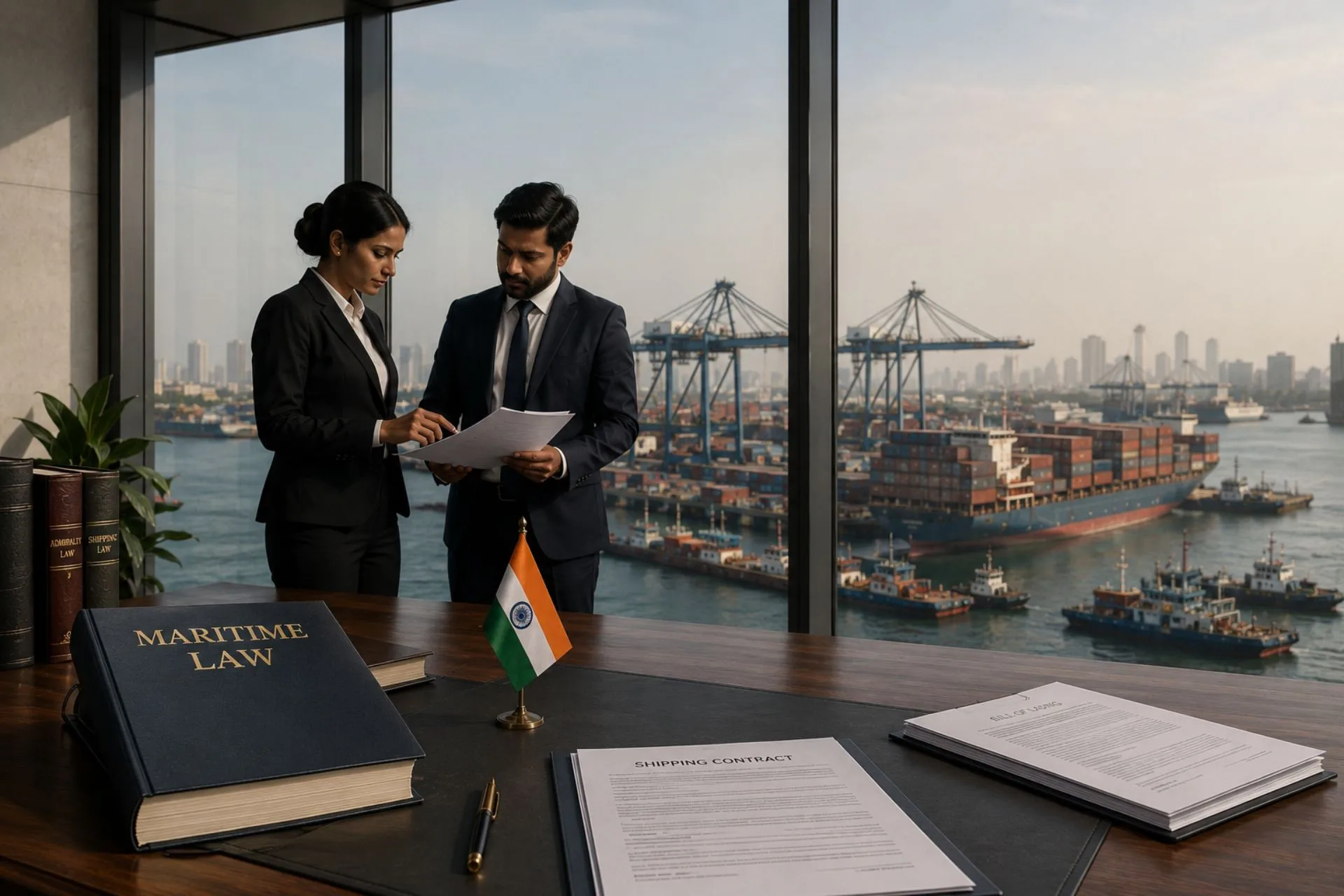
Can international trade and maritime commerce function effectively without a specialized legal framework governing the seas?
The answer lies in maritime law. Maritime law, commonly known as admiralty law, is a distinct branch of law that governs matters related to navigation, shipping, marine commerce, the carriage of goods by sea, marine insurance, and disputes arising from maritime activities. As international trade has historically depended upon sea routes, maritime law evolved to establish a legal framework governing the rights, obligations, and liabilities of parties engaged in maritime commerce.
In the contemporary world, a substantial portion of global trade is transported by sea, making maritime law indispensable to the functioning of the international economy. India, with a coastline exceeding 7,500 kilometres and several strategically important ports, occupies a significant position in global maritime trade and regional security. The development of maritime law in India reflects the influence of ancient maritime customs, English admiralty principles, international conventions, judicial precedents, and modern legislative reforms.
History of Maritime Law
The history of maritime law dates back to ancient civilizations that depended upon sea trade for economic prosperity. The earliest known maritime regulations emerged among the Phoenicians, Greeks, and Romans, who developed customary rules to govern commercial voyages and resolve disputes between merchants and ship owners. One of the oldest maritime codes is the Rhodian Sea Law, which originated around 800 B.C. on the island of Rhodes. The Rhodian principle of general average established that when cargo is intentionally sacrificed to save a ship during an emergency, the resulting loss should be shared proportionately among all parties involved in the voyage.
During the Roman period, maritime principles were incorporated into Roman commercial law and subsequently influenced European legal systems. In the medieval period, maritime trade expanded significantly, particularly in the Mediterranean region. Several maritime codes emerged during this period, including the Laws of Oleron in France, the Consolato del Mare in Spain, and the Laws of Wisby in Northern Europe. These codes dealt with matters such as cargo damage, collisions, freight charges, salvage operations, and the conduct of seafarers.
The growth of international commerce during the sixteenth and seventeenth centuries led to the establishment of admiralty courts in England. These courts exercised jurisdiction over maritime disputes and gradually developed principles that became the foundation of modern admiralty law. English maritime law significantly influenced the legal systems of British colonies, including India. The colonial administration introduced admiralty jurisdiction through statutes and established admiralty courts in the Presidency towns of Bombay, Madras, and Calcutta. Consequently, Indian maritime law evolved primarily under English legal traditions.
The twentieth century witnessed substantial international cooperation in maritime matters. Various international conventions were adopted to regulate shipping safety, marine pollution, carriage of goods, and liability issues. International organizations played a major role in harmonizing maritime regulations across nations. These developments transformed maritime law from a collection of local customs into a comprehensive international legal system.
Evolution of Maritime Law in India
The evolution of maritime law in India can be divided into three phases: the colonial period, the post-independence period, and the modern period. During British rule, admiralty jurisdiction was exercised by the High Courts of Bombay, Madras, and Calcutta under various colonial statutes, which formed the foundation of Indian admiralty law.
After independence, India retained many colonial laws while enacting legislations such as the Merchant Shipping Act, 1958 and the Marine Insurance Act, 1963. A major turning point came with the Supreme Court’s decision in M.V. Elisabeth, which expanded admiralty jurisdiction and recognized international maritime principles.
The enactment of the Admiralty (Jurisdiction and Settlement of Maritime Claims) Act, 2017 modernized Indian maritime law by replacing outdated colonial legislation and aligning it with international standards. Today, increasing maritime trade, technological advancements, environmental concerns, and India’s strategic position in the Indian Ocean continue to shape the evolution of maritime law in the country.
Background and Legal Framework
The legal framework of maritime law in India is derived from the Constitution, domestic legislation, international conventions, and judicial decisions. Shipping and navigation fall under the Union List, empowering Parliament to enact laws on maritime matters and ensuring uniform regulation throughout the country.
Key legislations include the Merchant Shipping Act, 1958, the Carriage of Goods by Sea Act, 1925, the Marine Insurance Act, 1963, and the Admiralty (Jurisdiction and Settlement of Maritime Claims) Act, 2017. These laws govern shipping operations, carriage of goods, marine insurance, maritime claims, and admiralty jurisdiction.
International conventions relating to maritime safety, pollution prevention, and seafarer standards also influence Indian maritime law. Additionally, Indian courts have played a crucial role in interpreting these laws and incorporating international maritime principles, thereby contributing to the development of modern admiralty jurisprudence.
Important Case Laws
Judicial decisions have played a vital role in the development of maritime law in India. One of the most significant cases is M.V. Elisabeth v. Harwan Investment and Trading Pvt. Ltd. (1993), where the Supreme Court held that Indian High Courts possess admiralty jurisdiction even in the absence of specific domestic legislation. The Court recognized the international nature of maritime law and permitted the application of established principles of international admiralty law, thereby considerably expanding the jurisdiction of Indian courts.
In Liverpool and London Steamship Protection and Indemnity Association Ltd. v. M.V. Sea Success I, the Supreme Court examined the scope of maritime claims and liens, emphasizing the importance of international conventions and clarifying principles relating to ship arrest and maritime claims.
Similarly, in Epoch Enterrepots v. M.V. Won Fu, the Court recognized the priority of maritime liens over other claims against a vessel, thereby strengthening the concept of maritime security interests in Indian law. The decision in Chrisomar Corporation v. MJR Steels Pvt. Ltd. further clarified the principles governing admiralty jurisdiction and the arrest of ships.
Following the enactment of the Admiralty (Jurisdiction and Settlement of Maritime Claims) Act, 2017, cases such as Sunil B. Naik v. Geowave Commander have interpreted the new statutory framework and clarified the scope of maritime claims. Collectively, these judgments have significantly shaped and modernized maritime jurisprudence in India.
Conclusion
Maritime law has evolved from ancient customs into a modern legal system governing international trade and navigation. In India, it has developed from colonial admiralty laws into a comprehensive framework shaped by international conventions, judicial decisions, and legislative reforms. The Admiralty (Jurisdiction and Settlement of Maritime Claims) Act, 2017 significantly modernized Indian maritime law and aligned it with international standards. As India continues to strengthen its maritime sector, effective legal regulation remains essential for promoting trade, ensuring maritime security, protecting the marine environment, and supporting economic growth.
At ABS Partners, we understand the complexities of maritime law and the challenges faced by businesses operating in the maritime sector. Our firm provides legal assistance in matters relating to shipping disputes, maritime claims, admiralty proceedings, and regulatory compliance. Through practical legal solutions and strategic advice, we are committed to protecting our clients’ interests and delivering effective legal support in maritime matters.